
TV White Space IoT Deployment with Microsoft Research
Published:
Project overview
This project documents my collaboration with Microsoft Research on deploying and evaluating TV White Space (TVWS) IoT radios at KAUST and beyond. The goal was to validate a new connectivity solution, originally developed in Microsoft’s Whisper project, that uses underutilized TV spectrum to deliver long-range, low-power links for Internet of Things applications.
Instead of relying solely on crowded ISM bands, TVWS offers lower frequencies and better propagation, which can significantly increase coverage for sensors in residential, urban, agricultural, and rural environments. My role was to design, implement, and analyze a series of real-world tests that show how this technology behaves in practice, and to identify the practical constraints, trade-offs, and next steps for wider deployment.
Collaboration with Microsoft Research
The TVWS IoT radios used in this project were designed and provided by Microsoft Research as part of the Whisper initiative, which explores low-power wide-area connectivity over TV spectrum. Working with these devices gave me the opportunity to:
- Collaborate directly with an industrial research team on a system they had recently proposed and published.
- Align local test plans at KAUST with the design assumptions and energy profiles described in the Whisper work.
- Provide detailed feedback and deployment insights from a new geographical and regulatory context (Saudi Arabia).
This collaboration helped me build experience in cross-institutional projects, where research ideas have to travel from paper to hardware and then to real-world environments.
System setup and hardware integration
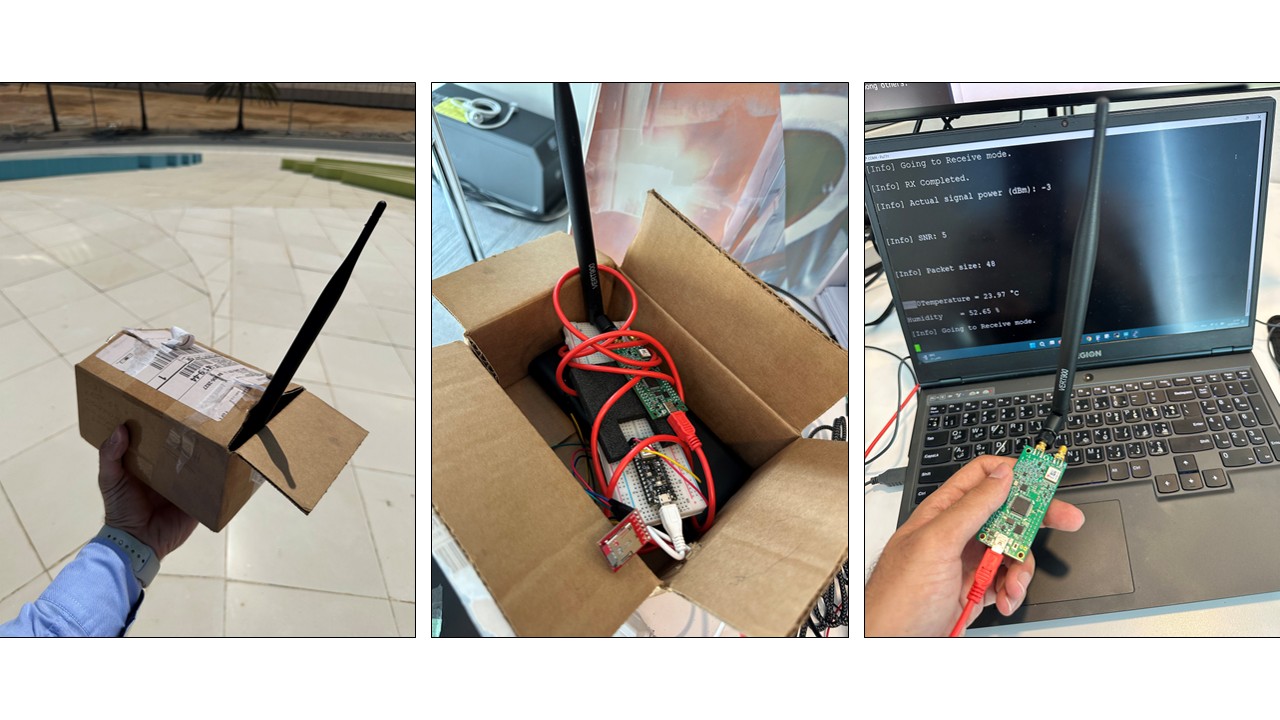
My first task was to build a complete, autonomous sensing node around the TVWS radio and to configure a corresponding gateway. The test platform included:
- Two Microsoft TVWS IoT radio terminals, with integrated Semtech radios supporting LoRa and FSK modulation and tunable between 150 MHz and 960 MHz.
- Arduino Nano 33 BLE Sense boards, providing multiple environmental sensors (temperature, humidity, motion, and others) and local processing.
- MicroSD card modules for logging sensor data locally at the node.
- GNSS antennas for precise positioning and timing.
- Omnidirectional antennas covering the relevant frequency bands.
- Laptop-based gateway interface for data visualization and logging.
- Power banks and field wiring for fully off-grid operation.
The sensor node was integrated into a compact, weatherproof box containing the TVWS radio, Arduino, SD card, and power source, with the antenna mounted externally for better signal quality. The node was configured to periodically measure temperature and humidity, store readings locally, and transmit them over the TVWS link without manual intervention. The gateway terminal was connected to a laptop, where I monitored and logged incoming data using a serial terminal.
Field deployments at KAUST
Once the nodes were integrated and configured, I designed a series of progressively more demanding field tests across the KAUST campus. The campus covers roughly five kilometers north–south and 4.5 kilometers east–west, with a mix of dense buildings, open spaces, and coastal sections.
Initial link deployments
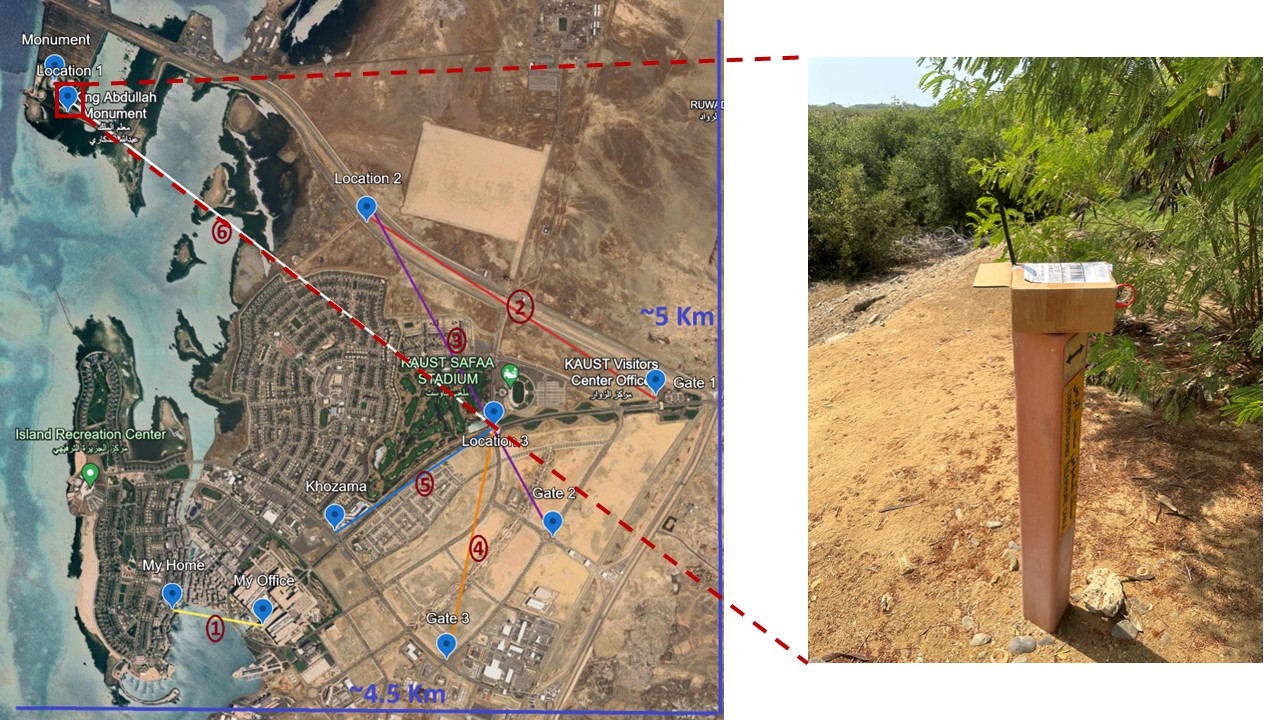
The first test used a configuration close to typical LoRa settings in the ISM band at 915 MHz, with a spreading factor of 7, 125 kHz channel bandwidth, and 17 dBm transmit power. I placed the receiving terminal in my office, about 10 meters above ground and facing a partially blocked line-of-sight. The sensor node was then moved around the surrounding area and toward my home, roughly 650 meters away.
Despite the blocked line-of-sight, the system maintained a stable link, with an average received signal power around −75 dBm and an average SNR of approximately −5 dB at 650 meters. The terminals were left running for an entire day, collecting a continuous stream of temperature and humidity readings.
Rural-style placement and height effects
To emulate rural deployments, I moved the sensor node to the north-western edge of KAUST and mounted it on a low pole, about one meter above ground. Using the same configuration as before, I walked away from the node and found that reliable reception stopped at around one kilometer. Repeating the experiment at a nearby location produced similar limits, which I attributed to:
- Lower antenna height at the transmitter.
- Partial blockage of line-of-sight by vegetation and buildings.
- The chosen modulation parameters.
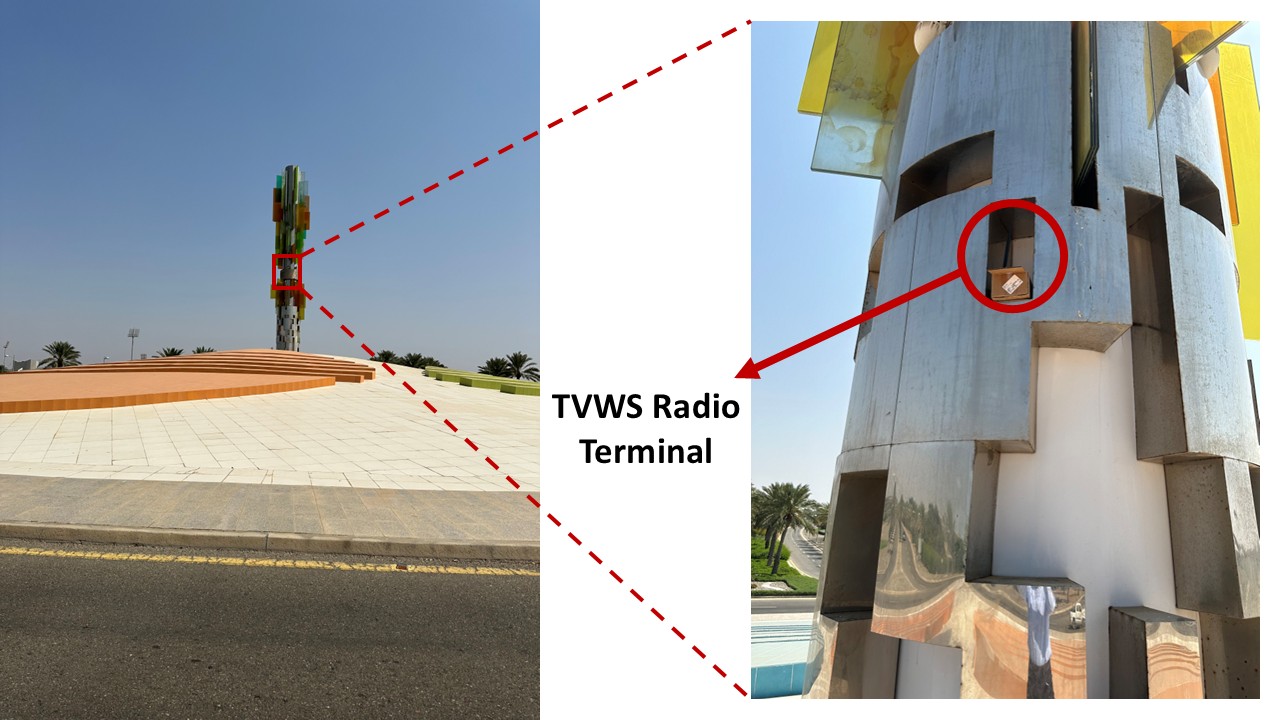
To better understand the effect of height, I relocated the node to a mid-height tower in the center of KAUST, placing it roughly five to six meters above ground. With updated parameters (spreading factor 12, 62.5 kHz bandwidth, 20 dBm transmit power, matching Whisper’s energy profile experiments), I measured several links: [ppl
- Approximately 1.7 km with good signal quality and line-of-sight.
- Approximately 1.4 km in a partially obstructed area, with slightly reduced SNR.
- A long link of about 4 km with partially blocked line-of-sight, where the system still maintained reception with SNR around −6 dB and received power near −85 dBm.
These tests highlighted how antenna height, environment, and configuration choices interact in real deployments, and how TVWS-based links can reach multi-kilometer distances in practice.
Extending tests to TVWS frequencies and larger distances
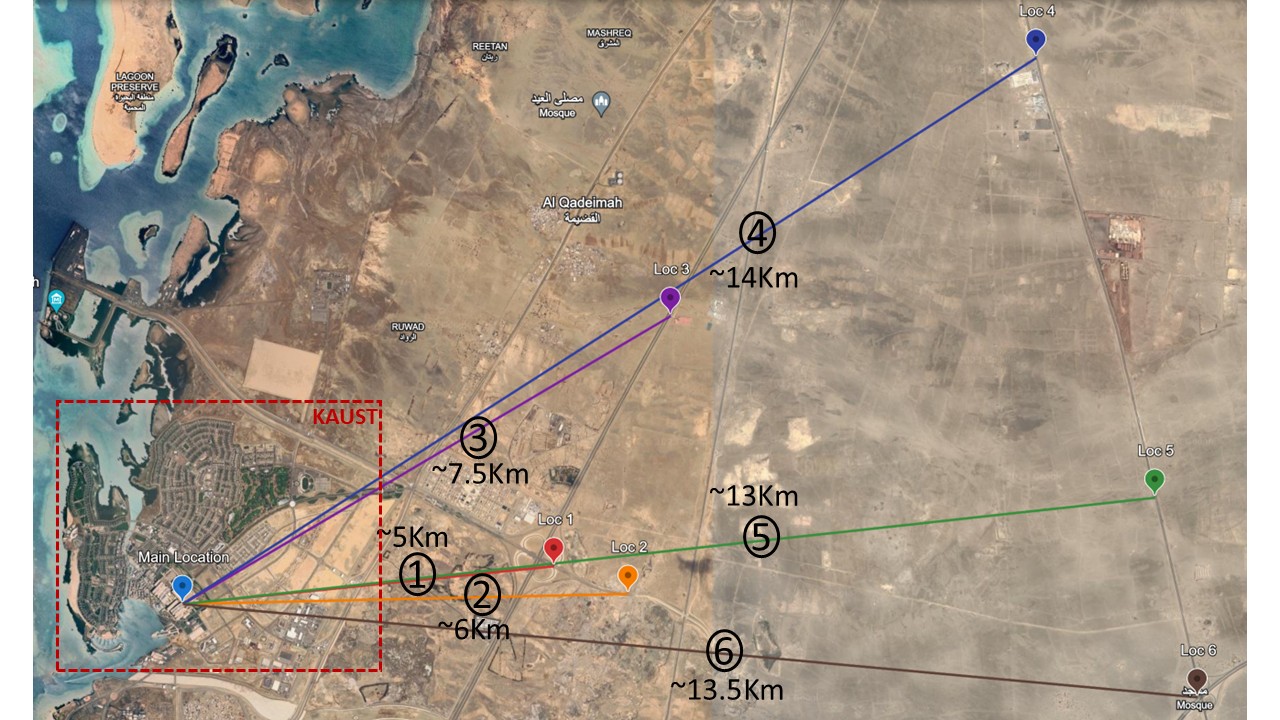
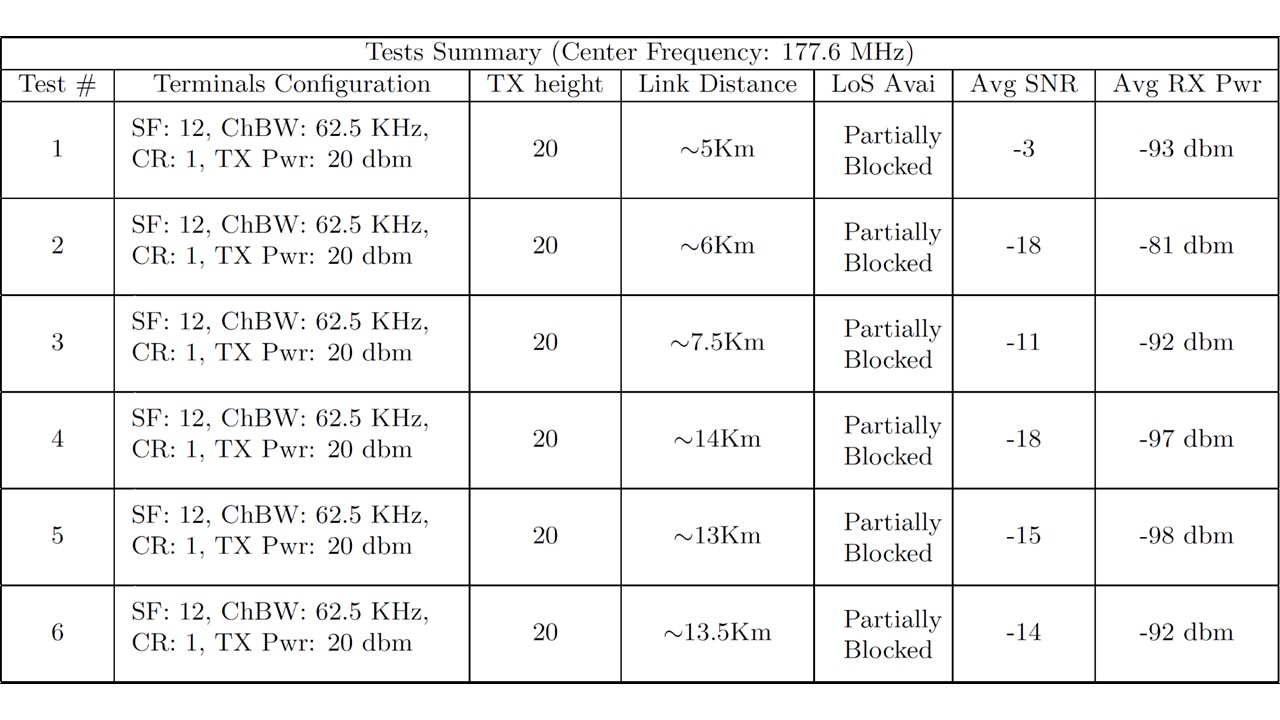
After validating the system in the 915 MHz ISM band, I conducted tests using TVWS frequencies such as 177.6 MHz, which better represent the Whisper design goals. With the sensor node positioned at approximately 20 meters height and using LoRa-style parameters tuned for robustness, the system achieved link distances in the range of 5 to 14 kilometers with partially blocked line-of-sight.
At these longer ranges, the received SNR and power were understandably lower, but the link remained functional, demonstrating the true long-range potential of TVWS IoT radios in realistic conditions. This phase of the project strengthened my understanding of:
- Frequency-dependent propagation and its impact on coverage.
- How to interpret and compare link budget, SNR, and reliability across very different distances.
- Practical challenges around antenna selection, mounting, and alignment at TVWS frequencies.
Skills and impact
This project helped me develop a set of concrete skills that go beyond simulation and theory:
System integration and embedded design
Designing and assembling a complete sensing node, combining microcontrollers, sensors, storage, power, and a specialized radio platform into a robust field device.Radio configuration and field testing
Selecting and tuning physical-layer parameters, planning measurement campaigns, and conducting repeatable tests under varying line-of-sight and height conditions.Measurement, analysis, and reporting
Logging and organizing data, analyzing link behavior across multiple environments and configurations, and summarizing findings in a structured technical report for both academic and industrial audiences.Industrial collaboration
Coordinating with Microsoft Research engineers, aligning experiments with prior work, and offering feedback that can inform future iterations of the technology.
From an impact perspective, the project provides evidence that TVWS-based IoT radios can deliver long-range, low-power connectivity in real deployments, making them promising candidates for large-scale sensing in agriculture, remote monitoring, and under-served areas where infrastructure is limited.
Next steps and future directions
Based on the deployment experience and results, I identified several directions for future work:
- Operating fully in the TVWS VHF and UHF spectrum with optimized antennas and regulatory support.
- Connecting the TVWS gateway to a cloud back-end to build end-to-end IoT solutions.
- Exploring data-rate improvements, for example by aggregating multiple narrowband channels to support image and large-file transfers.
- Investigating range extensions through relays, multi-hop networks, or mesh-style topologies.
These directions connect practical deployment insights with open research questions, and they position TVWS IoT radios as a strong candidate for the next generation of long-range IoT connectivity.
Photo Gallery