LoRaWAN Gateway Mesh: Experimental Evaluation and Protocol Analysis
Published:
Project overview
This project investigates the recently proposed LoRaWAN Gateway Mesh implementation developed by RAKwireless and ChirpStack. The core goal is to understand the protocol and software architecture, build a working multi-gateway testbed, and quantify performance in realistic field conditions.
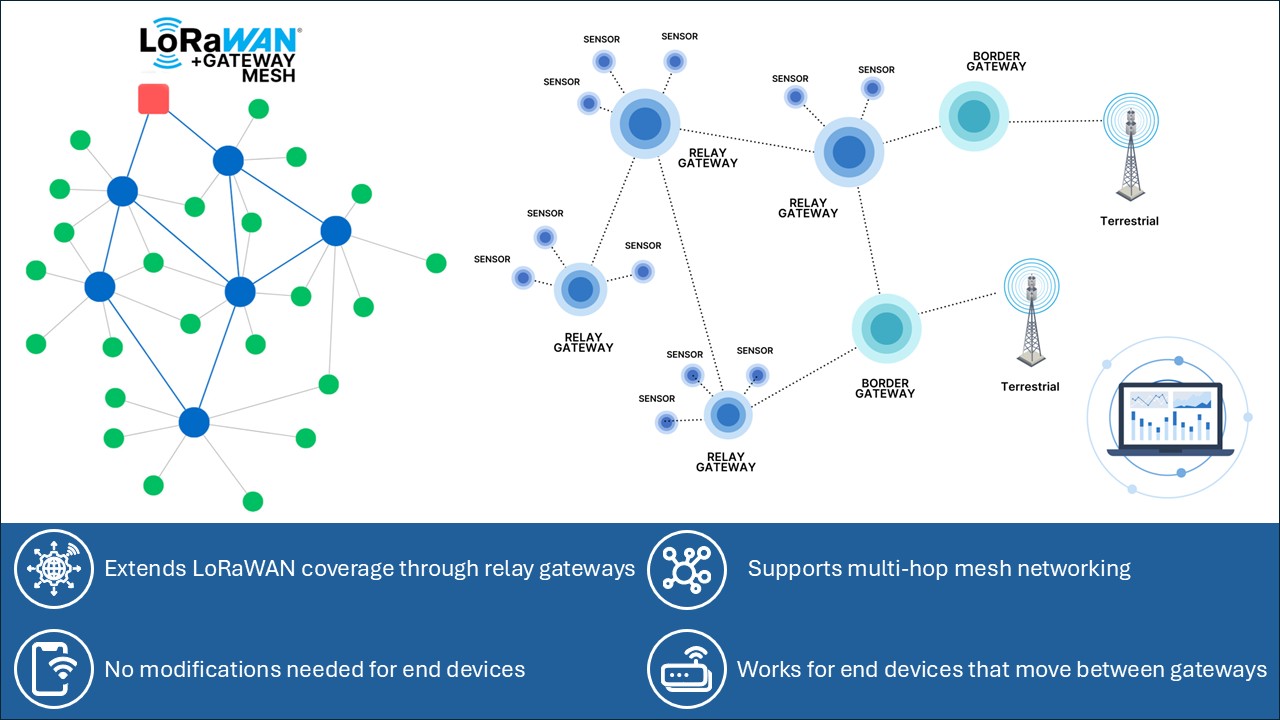
Unlike conventional single-hop LoRaWAN deployments, Gateway Mesh enables multi-hop relays between gateways so coverage can be extended without adding backhaul connectivity at every gateway. The mesh design preserves compatibility with standard end devices while enabling relay and border gateway roles within the network.
Reference: RAK Gateway Mesh Solution
Objectives
- Study how the RAK and ChirpStack Gateway Mesh protocol is implemented in practice.
- Configure and integrate a multi-gateway testbed (2 to 3 LoRaWAN gateways plus several end nodes).
- Run hands-on field experiments and capture performance limitations.
- Connect system behavior to hardware, software, and system design decisions.
System architecture in focus
The evaluation centers on the relay gateway and border gateway roles:
- Relay gateways forward uplink and downlink LoRaWAN payloads over LoRa-based backhaul links.
- Border gateways connect the mesh to a LoRaWAN Network Server (LNS), typically via Ethernet, Wi-Fi, or cellular backhaul.
- End devices do not require firmware changes, preserving standard LoRaWAN behavior.
Experimental plan
The experimental workflow is structured around two phases:
- Lab bring-up and validation
- Install and configure ChirpStack with Gateway Mesh support.
- Validate end-to-end links through single- and multi-hop mesh paths.
- Confirm time sync, channel plans, and relay/border role assignments.
- Field evaluation
- Outdoor and indoor trials with controlled gateway placements.
- Incremental hop counts to study latency and reliability trends.
- Mobility tests with moving end devices to observe handover behavior.
Performance metrics
The evaluation focuses on measurable, deployment-relevant metrics:
- Packet delivery ratio across hop counts and distances.
- Latency impact of relaying and mesh forwarding.
- Coverage extension compared to a single-hop baseline.
- Gateway resource usage (CPU load, memory, and backhaul bandwidth).
- Uplink/downlink reliability under different relay configurations.
Expected outcomes
This project aims to provide:
- A clear, reproducible testbed for Gateway Mesh deployments.
- Practical insights into protocol limitations, including hop overhead and latency.
- A comparison between single-hop LoRaWAN and multi-hop gateway mesh behavior.
- Guidance on hardware and configuration choices for real-world pilots.
Skills and impact
This work combines hardware deployment, network configuration, and field experimentation. It strengthens experience in:
- LoRaWAN gateway setup and mesh configuration.
- Protocol analysis and system-level troubleshooting.
- Experimental design for wireless network evaluation.
- Translating emerging research into deployable testbeds.
Related mentoring and poster
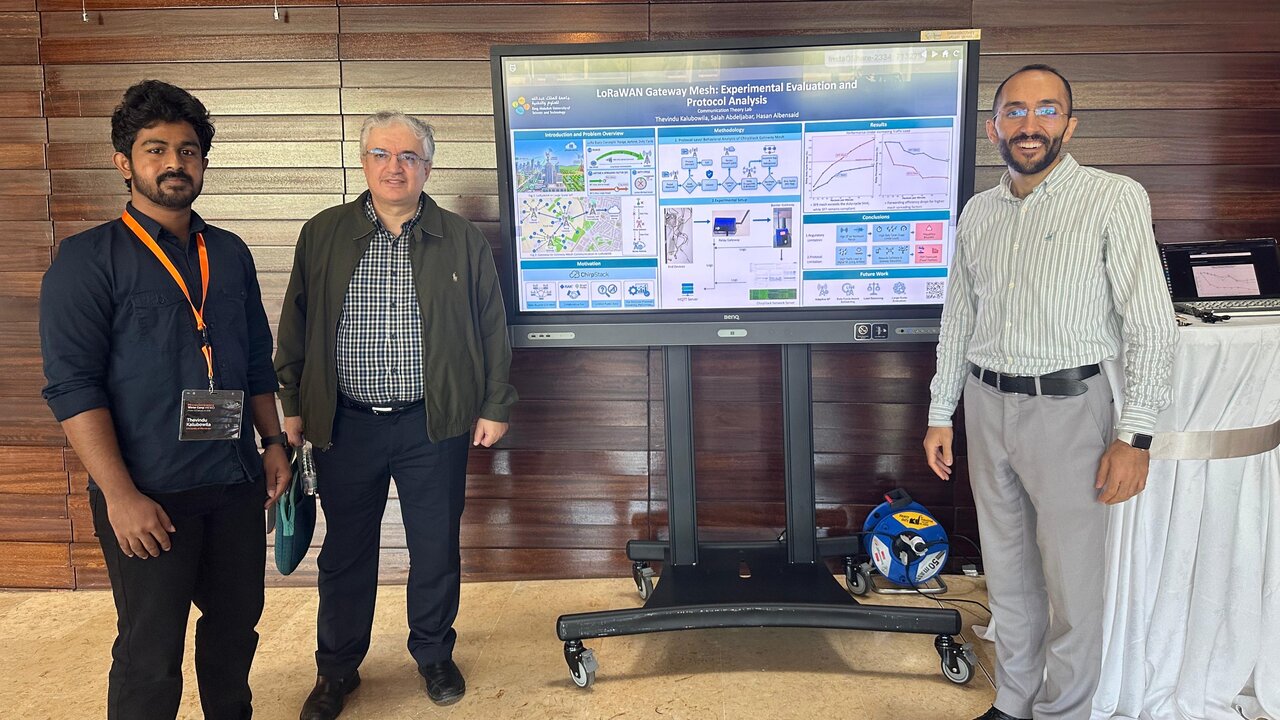
This project is closely tied to mentoring work at KAUST’s Communication Theory Lab (CTL). The poster and presentation photo capture the experimental storyline and early findings.
- Poster (PDF): LoRaWAN Gateway Mesh Experimental Evaluation and Protocol Analysis
- Poster presentation photo: